





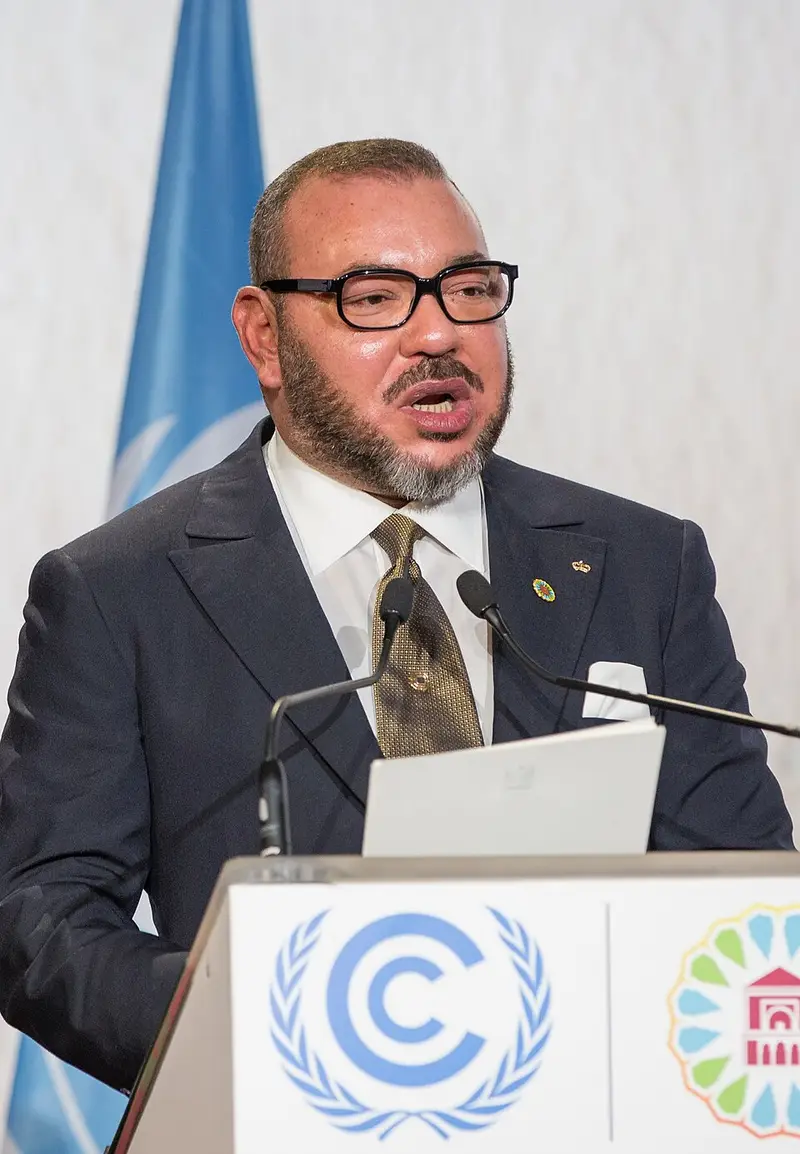
A legal initiative targeting King Mohammed VI and Moroccan Head of Government Aziz Akhannouch has sparked numerous reactions on social media over the past few days. Some commentaries are already speaking of an “earthquake in The Hague” or an international indictment of the Moroccan government. The reality, however, is more nuanced: a complaint has indeed been filed, but the International Criminal Court has not, at this stage, issued any indictments or announced the opening of an investigation.
A complaint filed by Iustitia Europa
On August 10, 2026, the Spanish political organization Iustitia Europa submitted a document to the Office of the Prosecutor of the International Criminal Court in The Hague, implicating Mohammed VI, Aziz Akhannouch, and potential Moroccan civil, police, or military officials.
The proceedings concern the massive crossings recorded in Ceuta on July 30 and 31, 2026. According to information published by several Spanish media outlets, the complainants are asking the prosecutor to determine whether the Moroccan authorities deliberately reduced or suspended border controls to allow thousands of people, including minors, to enter Spanish territory.
The document points to a possible instrumentalization of civilian populations intended to overwhelm Spanish capacities and exert political pressure on Madrid. Specifically, Iustitia Europa asks that any orders, communications, meetings, intelligence reports, or operational decisions be investigated to establish the involvement of the Moroccan state.
The complaint proposes examining the facts through the lens of “hybrid warfare,” as well as certain provisions of the Rome Statute relating to war crimes and the crime of aggression.
Filing a complaint does not mean opening a trial
The terminology used in certain publications can mislead the public. Mohammed VI and Aziz Akhannouch are currently neither indicted, prosecuted, nor convicted by the International Criminal Court.
An organization, a person, or a group may transmit information regarding alleged crimes to the Office of the Prosecutor. This communication is then analyzed to determine whether the alleged facts fall within the jurisdiction of the ICC and whether they justify further steps.
The mere recording or receipt of a document does not mean that the Court recognizes the truth of the accusations, nor does it constitute a judicial decision.
Furthermore, the complaint itself admits that there is currently no conclusive evidence establishing that an individual order was given by Mohammed VI or Aziz Akhannouch. It precisely requests that an investigation be conducted to determine whether they participated in the events, whether they had knowledge of them, or whether they authorized or tolerated them.
An uncertain legal qualification
The ICC does not judge governments for their general policies. It prosecutes individuals suspected of genocide, crimes against humanity, war crimes, or the crime of aggression.
Qualifying the political use of migration as “hybrid warfare” may have a diplomatic or strategic scope. However, this notion alone does not constitute an autonomous offense provided for by the Rome Statute.
To establish the qualification of a war crime, it would notably be necessary to establish a sufficient link between the acts complained of and an armed conflict. As for the crime of aggression, it meets particularly strict conditions related to the use of armed force by one State against another and raises significant jurisdictional questions in this case.
Even if a political manipulation of migratory flows were demonstrated, it would not automatically fall under the material jurisdiction of the ICC. Other national, European, or international jurisdictions could potentially offer different legal frameworks, depending on the acts and available evidence.
The Ceuta precedent in 2021
However, suspicions regarding the use of migration as an instrument of diplomatic pressure are not entirely new.
In May 2021, approximately 9,000 people entered Ceuta following a temporary relaxation of Moroccan controls. The crisis occurred amid tensions between Rabat and Madrid following the reception in Spain of Brahim Ghali, leader of the Polisario Front, for medical reasons.
The European Parliament had officially rejected “the use” of border control, migration, and particularly unaccompanied minors as a means of pressure against Spain. It had also considered that the crisis was linked to diplomatic tensions between the two countries.
This precedent gives a certain political credibility to questions regarding the use of migratory control as leverage. However, it is not enough to automatically demonstrate that the events of July 2026 were directly ordered by the highest levels of the Moroccan state.
Rabat attributes the recent crisis to disinformation spread on social media, the activity of smuggling networks, and a misinterpretation of a Spanish judicial decision. Meanwhile, observers emphasize that European dependence on transit countries gives them considerable leverage when they reduce or threaten to reduce their migration cooperation.
No public evidence of an operation organized by Israel
Some publications go much further, claiming that Morocco acted on behalf of Israel to punish Spain for its positions on Palestine or Iran.
To date, no solid public evidence establishes such a coordinated operation. Military, diplomatic, and security relations between Morocco and Israel are documented, but their existence does not prove that Israel sponsored or organized the events in Ceuta.
This accusation must therefore be presented as an unsupported political hypothesis, rather than an established fact. It is not among the elements confirmed by the International Criminal Court.
A real, yet embryonic case
The existence of the legal proceedings is very real. It forces us to question the protection of migrants and minors, the political responsibilities surrounding border control, and the vulnerability of the European Union to the potential instrumentalization of population movements.
However, speaking of an international conviction of Mohammed VI or Aziz Akhannouch at this stage would be inaccurate. The case is at the stage of a communication addressed to the prosecutor by a Spanish political formation. It remains to be seen whether the Office of the Prosecutor will follow up on it and, above all, whether the alleged facts can legally fall under the Rome Statute.
The most rigorous conclusion is therefore twofold: the complaint exists and suspicions of migratory instrumentalization deserve serious examination, but no individual criminal responsibility has yet been established.
Originally published in Opinion Mondiale.