







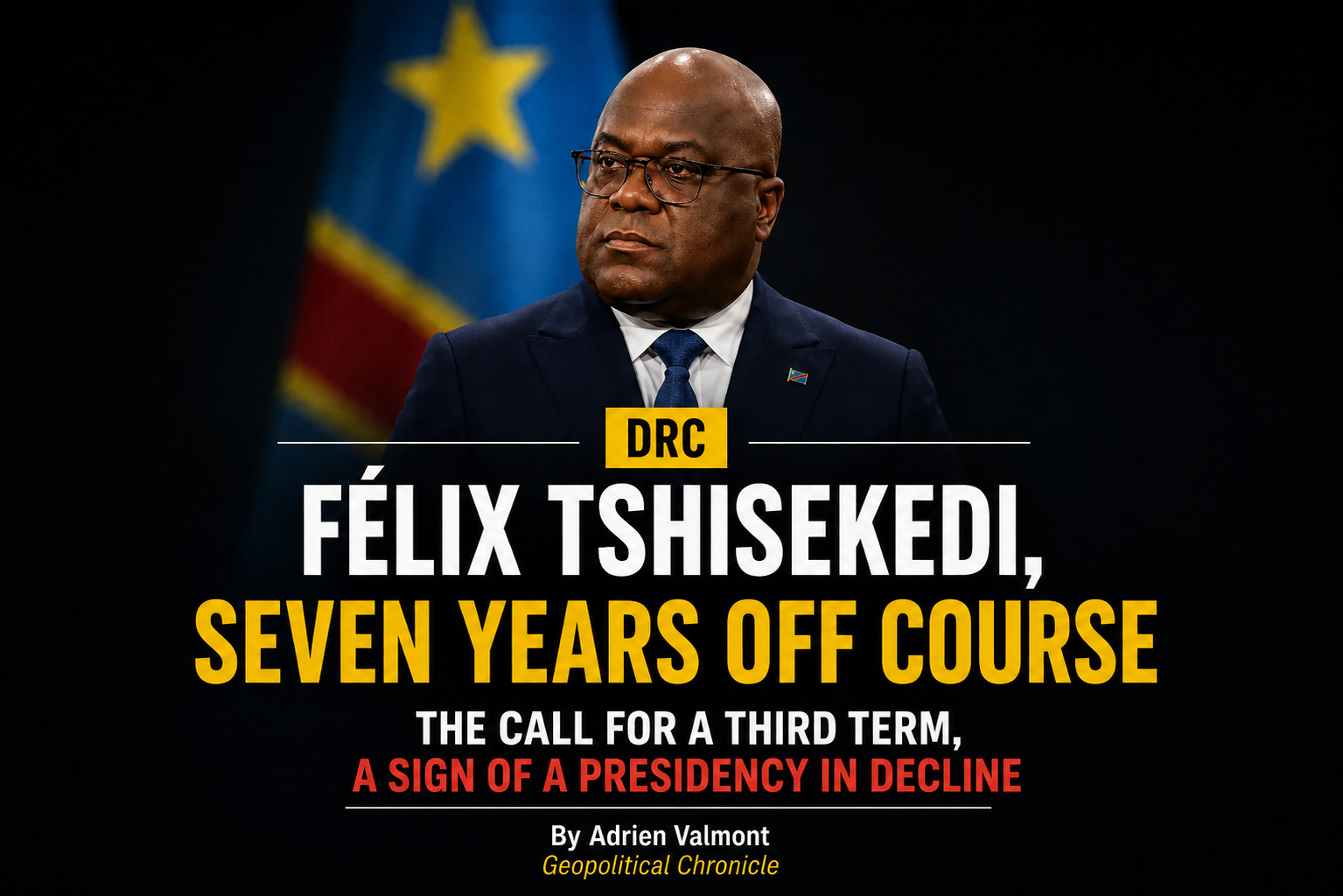
Introduction: The trap of power In January 2019, Félix Tshisekedi took the oath of office on the 2006 Constitution, promising to respect it “in its letter and in its spirit.” Seven years later, the same man opens the door to a third term, conditions the 2028 elections on the security situation, and wields constitutional revision as a political tool. This turnaround is no surprise: it is the symptom of a disastrous record that the head of state is trying to mask behind a democratic veneer. Because in the Democratic Republic of Congo, the reality is relentless: insecurity has worsened, the economy is struggling to take off, and governance is faltering. The third term is not a popular ambition. It is a flight forward.
I. A security record: a glaring failure When Félix Tshisekedi came to power, 121 armed groups were rampant in the east of the country. Today, the most optimistic analysts talk about double or even quadruple that number. According to Human Rights Watch, more than 100 armed groups were active in the eastern DRC in 2024/2025, mainly in the provinces of Ituri, North Kivu, and South Kivu. This is an unequivocal admission of failure.
The year 2025 was marked by a dramatic escalation of the conflict. On January 27, 2025, Goma, the strategic capital of North Kivu, fell into the hands of M23 rebels, supported by the Rwandan army. The offensive left at least 3,000 dead and 4,260 injured, according to official government figures. Hundreds of lifeless bodies were still lying in morgues. Bukavu fell on February 14, followed by Uvira. In March 2025, Walikale-Centre was also taken by the M23. Millions of Congolese have been displaced, adding to a record 6.9 million internally displaced persons in 2024.
The state of siege, established in May 2021 in North Kivu and Ituri with the promise to “pacify the East,” was a fiasco. Instead of restoring security, it served as a pretext for restrictions on freedoms and ineffective militarization. Tshisekedi congratulated himself for having “reduced customs fraud,” but the Congolese people did not elect a president to optimize customs revenues in a war zone. They elected him to protect their lives and their lands.
The government’s response, the recruitment of “Wazalendo” militias—armed and poorly trained civilians thrown into a war they do not master—is the admission of a defeated national army and a security strategy in decomposition. These militias, allied with the FARDC, have been implicated in violations of the laws of war. Sexual violence is also endemic, with more than one in ten women in displacement camps reporting having been raped between November 2023 and April 2024.
II. The economy: misleading numbers and real suffering The government boasts of inflation brought down from 11.7% to 2.5% at the end of 2025, a budget increased from 5.7 to 16 billion dollars, and foreign exchange reserves multiplied by five. Beautiful figures. But figures do not feed people.
The economic truth is different: the Congolese franc has collapsed, going from 1,700 to 2,600-2,700 francs for one dollar in a few years. The USD/CDF exchange rate even reached a peak of 2,913.50 in August 2025, before a relative stabilization around 2,320 in June 2026. The state struggles to pay its civil servants. More than two-thirds of the population lives below the poverty line, set at 2.15 dollars per day. The economy remains a prisoner of the mining sector, whose profits benefit multinationals and business networks more than the state coffers.
Tshisekedi may celebrate a “rediscovered macroeconomic discipline,” but Congolese observe that prices at the pump, the cost of living, and food insecurity are not receding. An increase in the prices of basic commodities (rice, maize) was reported in Kinshasa in May 2026. The agreement with the IMF for 3 billion dollars is a band-aid on a wooden leg. Food sovereignty, although promised, remains a pious wish in a country that imports what it could produce.
III. Governance: corruption, forced cohabitation, and battered democracy Tshisekedi’s first term was marked by a forced coalition with the “forces of the past” Kabilaists, in a “Sacred Union” that served more to share positions than to govern. The promised judicial reforms were buried by internal resistance. The fight against corruption, though brandished as a standard, did not lead to exemplary convictions. The DRC obtained a score of 20/100 on Transparency International’s 2025 Corruption Perceptions Index (CPI), ranking it 163rd out of 182 countries, highlighting persistent corruption.
The December 2023 elections, which gave Tshisekedi a second term, were marred by massive malfunctions, pre-printed ballots, and a lack of transparency denounced by the opposition and international observers. The CENCO-ECC Electoral Observation Mission (MOE) noted “massive irregularities.” Martin Fayulu, Moïse Katumbi, and other leaders were muzzled, marginalized, or silenced by a well-oiled state machine.
And when the opposition organized itself, it was weakened by successive electoral defeats, sometimes contested, and by targeted repression. Recent examples include the sentencing of Seth Kikuni to one year in prison in November 2024 for “spreading false rumors” and “incitement to civil disobedience,” as well as the arrest of Fred Bauma and Bienvenu Matumo of the Lucha movement in February 2024.
IV. The third term: a political maneuver disguised as democracy It is in this context of a disastrous record that Félix Tshisekedi, on May 7, 2026, dropped this phrase: “I have not requested a third term, but if the people wish for me to have a third term, I will accept.” This statement, made during a press conference that had “the air of a rally” with his “communicators” and members of the government, is a classic from the manual of African presidents at the end of their mandate.
The “people” are invoked, but it is the political machine that pushes. The referendum is promised, but in a country where the state controls the media, justice, and electoral administration, a referendum is merely a formality.
The pretext advanced? The security situation in the East could justify a postponement of the 2028 elections. This is a perverse logic: the president who failed to pacify the country would use this failure to stay in power. Article 220 of the Constitution, which locks the number and duration of presidential terms, would be bypassed by a “change” of Constitution, and not a simple revision.
The arguments brandished by the presidential camp are grotesque. The Constitution is allegedly “outdated,” “drafted abroad,” and undermines sovereignty through its Article 217 on international treaties. Martin Fayulu and Moïse Katumbi responded with absolute clarity: the delay in appointing the Prime Minister has no constitutional basis, and sovereignty is not to be confused with territory.
The Sacred Union, which holds an overwhelming majority in Parliament, can pass a project by a three-fifths majority. The referendum, if organized, will be a formality in a country where the opposition is weakened and civil society, like the Lucha movement, is harassed.
V. The Kabila precedent and the unlearned lesson In 2011, Joseph Kabila had already revised the Constitution to switch to a single-round voting system. In 2015, his attempt to modify the Constitution for a third term provoked bloody demonstrations. Tshisekedi, who benefited from the mobilization against Kabila to achieve power, is today reproducing the same methods. He has become what he fought against.
The 2006 Constitution, despite its imperfections, had one merit: it set up safeguards. Article 220 prohibits touching the republican form, universal suffrage, political pluralism, and the number of terms. These “locked articles” are today threatened by a president who, for lack of having governed, chooses to cling on.
Conclusion: A people taken hostage Félix Tshisekedi has not requested a third term, he says. But he has done everything to open the way. He appointed communicators, muzzled the opposition, controlled institutions, and prepared public opinion for the idea that “the people” will decide. This is the rhetoric of strong presidents who feel weak.
The record is there: the east of the country is in ruins, the economy is an empty shell for the majority, corruption persists, and democracy is a facade. The third term is not a solution. It is the flight forward of a man who did not know how to govern and who refuses to leave.
The DRC deserves better than this trap. It deserves a president who respects the Constitution he swore to defend, and not a man who tears it up to save his ego.
(*) Adrien Valmont is a French journalist specializing in African geopolitical issues and the transformations of the contemporary world.