

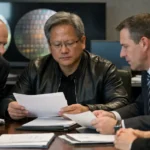








Nvidia has opened a review after reports that its chief executive, Jensen Huang, was the target of a Chinese intelligence operation. The company’s response follows reporting by The New York Times and places one of the world’s most closely watched technology leaders at the centre of a sensitive security matter. Nvidia, a dominant force in semiconductors and advanced computing, has said it is looking into the claims.
The publicly available information frames the issue as a reported intelligence targeting effort rather than a confirmed breach or proven misconduct by Huang. That distinction is significant: the allegation concerns an external operation focused on a senior executive whose company plays a major role in the global chip supply chain. Nvidia’s chips are widely associated with artificial intelligence systems, data centres and high-performance computing, sectors that have become strategically important for companies and governments alike.
The case arrives at a time when the technology industry is under heightened scrutiny over security, access to advanced hardware and exposure to geopolitical risk. Senior executives at major chipmakers can possess commercially sensitive knowledge about product road maps, customers, supply constraints and strategic partnerships. For that reason, any suggestion that an intelligence service targeted a leading figure in the sector is likely to attract attention from investors, policy specialists and corporate security teams, even before the facts are fully established.
For Nvidia, the immediate challenge is to assess the substance of the reports while avoiding conclusions that have not been verified. The company’s prominence in artificial intelligence has made it a central player in the broader technology economy, and developments involving its leadership can carry reputational and market implications. The review also highlights a wider concern for global companies operating across politically sensitive markets: protecting executives and proprietary information has become part of corporate resilience, alongside product security and regulatory compliance.