








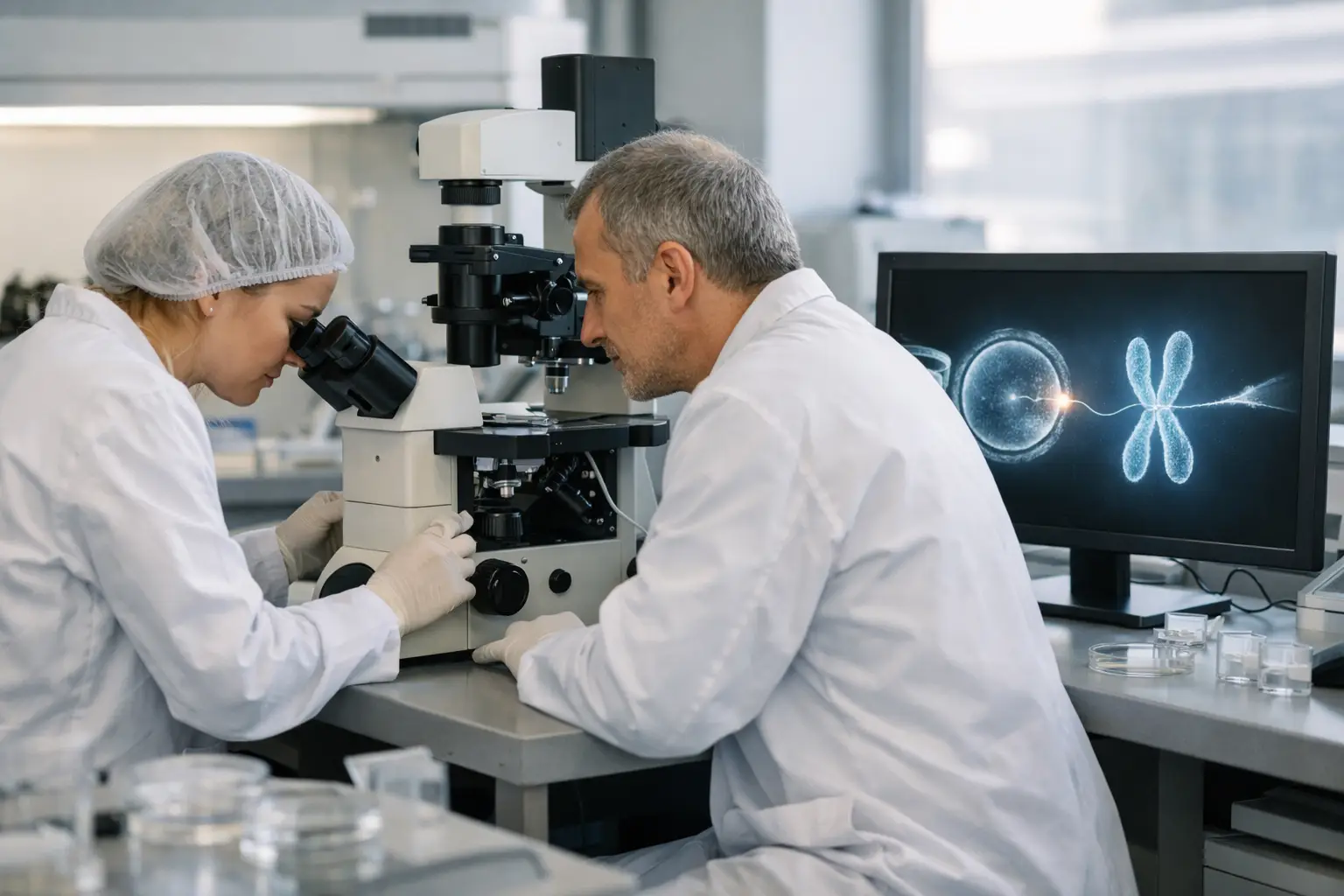
A laboratory advance in reproductive biology has shown that engineered proteins can restore more stable chromosome connections in aging mouse eggs, addressing one of the central biological obstacles in fertility treatment. Researchers at the Max Planck Institute for Multidisciplinary Sciences in Göttingen, Germany, developed a system designed to compensate for the weakening of cohesin, a protein complex that helps keep chromosomes correctly paired before cell division.
The work, published in Science, focuses on aneuploidy, the condition in which eggs or embryos carry an abnormal number of chromosomes. Aneuploidy is a leading reason for age-related infertility, failed IVF cycles and miscarriage. The problem becomes markedly more common around the age of 40, when chromosome separation during egg maturation is more likely to go wrong. Previous studies have estimated that 50% to 80% of embryos from women in their 40s carry chromosomal abnormalities.
Cohesin acts as a form of biological adhesive, holding chromosomes together until the moment they must separate. Unlike many proteins that are regularly replaced, cohesin in eggs can remain in place for years. As eggs age, this support weakens, increasing the risk that chromosomes will divide unevenly. The Max Planck team engineered a protein-based system intended to re-establish those links in older mouse eggs, effectively adding a synthetic stabilizing mechanism where the natural one had declined.
The findings are significant because they target a cause of chromosomal error rather than only selecting embryos after abnormalities have already occurred. In current reproductive medicine, IVF laboratories can test embryos for chromosomal status, but the formation of abnormal eggs remains a major limitation. A technique able to reduce chromosome mis-segregation at the egg stage could reshape part of the scientific approach to reproductive medicine, especially for patients affected by age-related egg quality decline.
The research remains preclinical and was carried out in mouse eggs, not in human treatment. Any possible application for human IVF would require extensive further testing to establish safety, effectiveness and ethical acceptability. Still, the study provides a concrete proof of principle: the chromosomal instability associated with aging eggs may be biologically modifiable, opening a new research path in the effort to understand and potentially reduce one of the most persistent barriers to later-life conception.